
Check Ford County's Current Owner Record Card
The Ford County Appraiser keeps the current assessment record. Portal labels and result layouts may vary. Capture these fields when they appear on the dated card:
| Owner / owner of record | The party carried for the roll date, with exact spelling and capacity |
|---|---|
| Mailing address | The destination for appraisal notices; it may be a post office box or off-site address |
| Situs address | The physical property being checked |
| Parcel number | The full APN used to hold the same land across county files |
| Legal description | The subdivision, lot and block, or rural description that tests the deed match |
| Last sale or deed reference | A possible bridge to the latest instrument, if the live card displays one |
An Appraiser record supports a present-tense, date-qualified statement. It does not establish occupancy. Not every field is guaranteed to appear in the portal, so save a copy or note the date checked before comparing it with the deed.
Measure How Current Ford County's Owner Roll Is
The Appraiser values real property on January 1. That fixed date anchors the roll. County guidance says valuation notices are mailed by or on March 1, and they go to the owner recorded with the Register of Deeds. The gap is practical. A later grantee can appear in a recorded deed while the appraisal notice still bears the earlier roll name.
Ford County publishes no exact parcel-card refresh interval. It promises no same-day updates from the Register either. Record the roll year and your access date, then look for any deed recorded after that point. Never call a card "today's owner" without that second check. The Ford County Appraiser page is the starting point for office details and a parcel search, and the official Appraiser page also lists current contact routes.
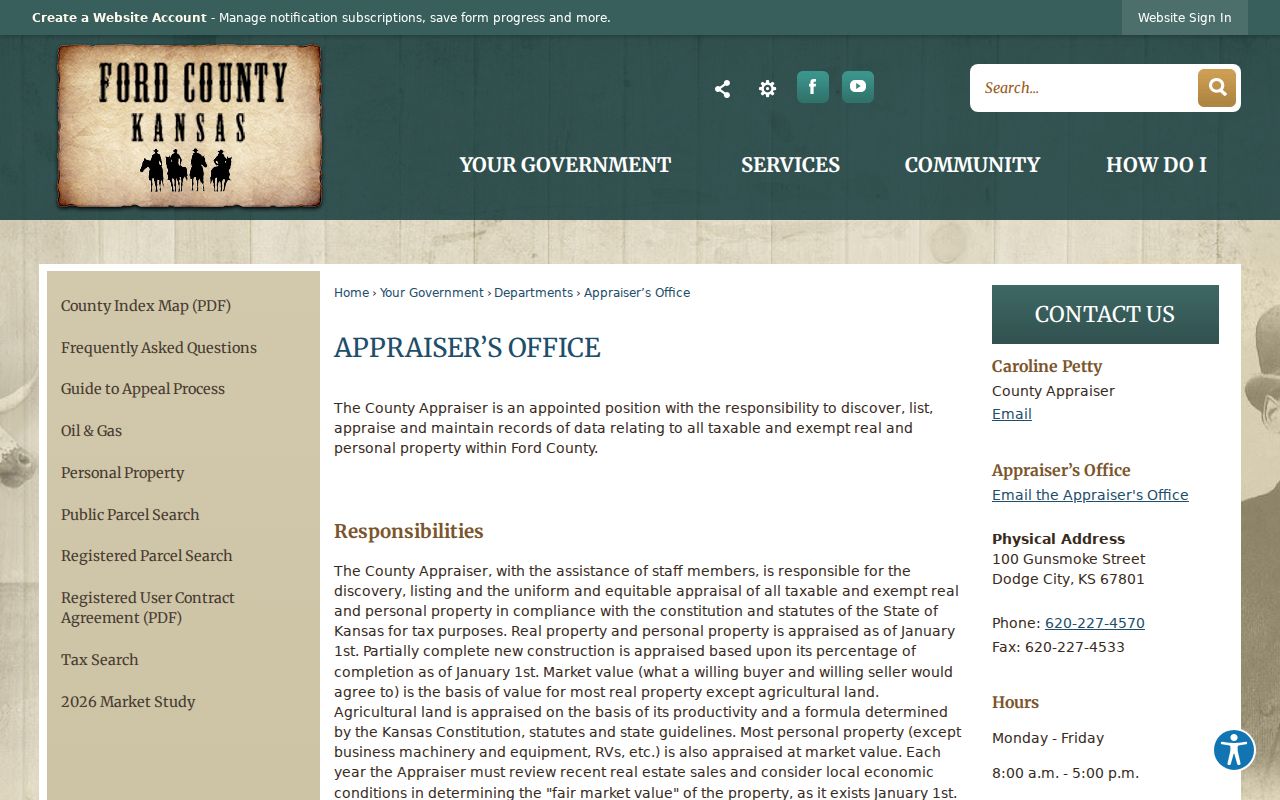
The image shows office context, not a live result. A parcel card still has to be opened and dated before it proves anything.
Separate Ford County Mailing and Situs Fields
A mailing address says where notices go. The situs identifies the land or building. The two can differ for many reasons: a post office box, a fiduciary contact, an entity office, an out-of-area correspondence choice, or Kansas address-confidentiality rules. None of those patterns alone shows who lives at the site.
Record terms. An assessment roll drives valuation and tax work. The owner of record is the party named there. Situs means property location, while recording lag is the interval before a later conveyance is reflected elsewhere.
Use the mailing field exactly as printed for lawful property correspondence. Keep it separate from the subject address. Kansas Safe at Home may place a substitute address in public records, so never try to uncover a protected location.
Verify the Present Ford County Owner
The deed comparison stays narrow. Test the most recent matching conveyance against the appraisal card; general portal mechanics belong on the property search page, and this check concerns only currentness.
- Open the county-linked parcel search when available and copy the owner name, APN, legal description, roll year, and mailing/situs fields.
- Use the Register's Tapestry or Laredo route to find the newest deed under that grantee and description.
- Compare the instrument's recording date, document number, grantee, and land description. A deed newer than the roll deserves priority in the current-owner note.
- If a company is the grantee, verify its exact legal name and status in the Kansas Secretary of State system without substituting an agent or member for the owner.
- Owner of record
- The party printed on a named record as of its date.
- Vesting
- The deed language stating how the grantee takes the interest.
- Resident agent
- A business contact in the state filing, not necessarily an owner of the parcel.
Recent sale check. The roll can lag a recorded transfer. The newest matching deed is the more current source when its date and legal description clearly fit the parcel.
Read a Ford County LLC or Trust Owner Now
A current owner may be printed as an LLC, trust, estate, or trustee rather than a familiar name. Search the exact spelling first. Then try punctuation or initial variants. Keep the capacity words, because "trustee," "executor," or "administrator" can explain why a person appears beside the entity.
The Kansas Business Entity Search accepts a business name, Kansas business ID, or resident-agent route. Results stop at the first 200. It excludes sole proprietorships, DBAs, and trade names. A business filing clarifies identity, but the newest deed is what links the organization to a Ford County parcel.
Request a Dated Ford County Parcel Card
Should the parcel application stay out of reach, call the Appraiser at 100 Gunsmoke Street in Dodge City, 620-227-4570, during the posted weekday hours, 8 a.m. to 5 p.m., Monday through Friday. Request the property record card by exact address. You can also supply the full parcel number, the legal description, or the roll year. Any of those identifiers helps the office pull the right card quickly.
When an existing record is not exempt, the Ford County KORA form opens a formal path. It asks you to describe the record, give contact details, choose a delivery method, and sign. Kansas guidance expects a prompt response, generally within three business days, or an explanation when more time is required. Reasonable actual costs may apply.
Note: Request the existing dated card and its named fields, because KORA does not require the office to build a new owner report.
Monitor the Current Ford County Owner Name
The Register of Deeds offers free Property Fraud Alert enrollment. A notice can flag a new instrument indexed under a watched name. The service cannot block a filing. It cannot judge validity either. It also will not update the Appraiser card. Treat it as a monitoring layer after the current owner is verified.
Save the alert date and instrument number. Then contact the Register of Deeds at 620-227-4565 to inspect the filing itself. A copied alert never replaces the recorded document.
Cross-Check Ford County's Current Owner Fields
A deed still settles ownership. But the tax and map side of Ford County records can flag a mismatch fast. The county tax page ties together parcel search and tax search. It also offers statement reprints, paid receipts, and registered-parcel search. Pull a current statement and compare it against the Appraiser record. The parcel identity and roll context should line up exactly. Read the owner field as of the statement's date, nothing more.
The GIS application helps confirm the APN sits where you expect. Its tools include Search, Query, Measure, a table view, and coordinate entry. The county publishes no live owner popup in that map configuration. Treat a map label as a clue, never as an ownership conclusion.
Why do mismatches happen? A recent deed can explain one. So can a corrected description, an address change, a parcel split, or a simple selection error. Preserve both records rather than choosing between them. Give the Treasurer any statement questions. Route spatial questions to GIS/Survey. Take roll questions to the Appraiser. Send recording questions to the Register of Deeds.
The April 1, 2025 tax-sale parcel file doubles as a handy field checklist. It lists APN, tax code, legal description, property address, delinquent years, dated charges, owner of record, and interested parties. It is not a current owner source on its own. If it conflicts with a parcel card, keep the publication date in view. Then check whether a later deed or redemption changed the record.
Contact a Ford County Current Owner Lawfully
Legitimate property issues sometimes require contact. Address any letter to the owner name and mailing address exactly as the dated roll shows them. Keep the parcel number and situs in your file. A returned letter or a different occupant does not undo the ownership conclusion. Recheck the latest deed and ask the Appraiser whether a newer public card exists.
Remember what a parcel roll actually proves. It names an administrative owner field, not whoever is standing on the property. That distinction matters most in estate work, boundary disputes, and purchase due diligence. It also matters for notice about an easement. Respect any substitute address, and honor whatever redaction Kansas law requires.
Lawful use. Use Ford County owner data only for a valid property or civic purpose. Never use it to stalk, harass, threaten, or target a person.